
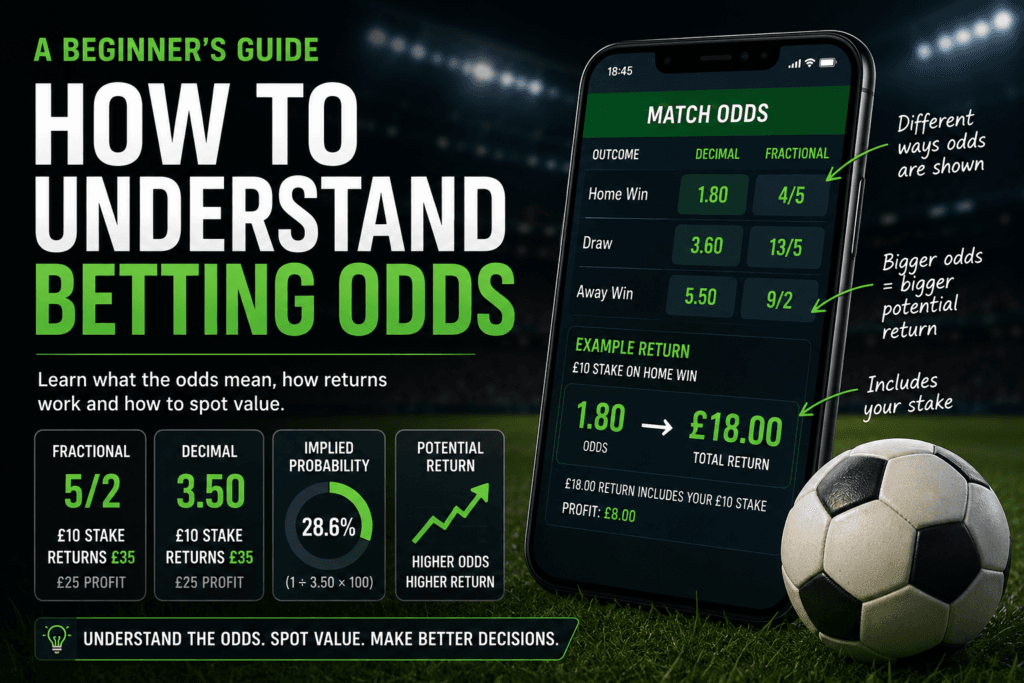
How to Understand Betting Odds
If you are new to football betting, learning how to understand betting odds is one of the first things to get right. Odds show the potential return on a selection, but they also give an idea of how likely the market thinks that outcome is.
Whether you are looking at match result odds, bet builders, both teams to score, over 2.5 goals or player props, the odds are the starting point for understanding risk and reward.
In simple terms, shorter odds usually suggest that an outcome is more likely, but the return is lower. Bigger odds usually suggest that the outcome is less likely, but the potential return is higher.
This does not mean a short-priced bet is guaranteed to win, and it does not mean a bigger-priced bet is impossible. Odds are only a market view of probability and price.
The key to learning how to understand betting odds is knowing the difference between total return, profit and implied probability. Once those basics are clear, it becomes easier to compare prices and decide whether a selection looks fair.
What do betting odds mean?
Betting odds show the price available for a particular outcome. In football, this could be a team to win, both teams to score, over 2.5 goals, a correct score, a player to score, or a bet builder selection.
For example, if Arsenal are priced at 1.50 to win, that means a £10 stake would return £15 if the bet wins. That £15 includes your original £10 stake, so the profit would be £5.
If another selection is priced at 4.00, a £10 stake would return £40 if it wins. That includes your £10 stake, so the profit would be £30. The bigger price offers a bigger return, but it also usually means the outcome is considered less likely.
Odds conversion table
This odds conversion table shows common fractional odds, decimal odds and implied probability. It is useful when comparing prices across different bookmakers or checking what a football betting price means in percentage terms.
| Fractional odds | Decimal odds | Implied probability |
|---|---|---|
| 1/5 | 1.20 | 83.30% |
| 2/9 | 1.22 | 81.80% |
| 1/4 | 1.25 | 80.00% |
| 2/7 | 1.29 | 77.80% |
| 3/10 | 1.30 | 76.90% |
| 1/3 | 1.33 | 75.00% |
| 4/11 | 1.36 | 73.30% |
| 2/5 | 1.40 | 71.40% |
| 4/9 | 1.44 | 69.20% |
| 1/2 | 1.50 | 66.70% |
| 8/15 | 1.53 | 65.20% |
| 4/7 | 1.57 | 63.60% |
| 8/13 | 1.62 | 61.90% |
| 4/6 | 1.67 | 60.00% |
| 8/11 | 1.73 | 57.90% |
| 4/5 | 1.80 | 55.60% |
| 5/6 | 1.83 | 54.50% |
| 10/11 | 1.91 | 52.40% |
| 1/1 | 2.00 | 50.00% |
| 21/20 | 2.05 | 48.80% |
| 11/10 | 2.10 | 47.60% |
| 23/20 | 2.15 | 46.50% |
| 6/5 | 2.20 | 45.50% |
| 5/4 | 2.25 | 44.40% |
| 11/8 | 2.38 | 42.10% |
| 7/5 | 2.40 | 41.70% |
| 6/4 | 2.50 | 40.00% |
| 8/5 | 2.60 | 38.50% |
| 13/8 | 2.62 | 38.10% |
| 7/4 | 2.75 | 36.40% |
| 9/5 | 2.80 | 35.70% |
| 15/8 | 2.88 | 34.80% |
| 2/1 | 3.00 | 33.30% |
| 11/5 | 3.20 | 31.20% |
| 9/4 | 3.25 | 30.80% |
| 12/5 | 3.40 | 29.40% |
| 5/2 | 3.50 | 28.60% |
| 13/5 | 3.60 | 27.80% |
| 11/4 | 3.75 | 26.70% |
| 3/1 | 4.00 | 25.00% |
| 16/5 | 4.20 | 23.80% |
| 10/3 | 4.33 | 23.10% |
| 7/2 | 4.50 | 22.20% |
| 4/1 | 5.00 | 20.00% |
| 9/2 | 5.50 | 18.20% |
| 5/1 | 6.00 | 16.70% |
| 11/2 | 6.50 | 15.40% |
| 6/1 | 7.00 | 14.30% |
| 13/2 | 7.50 | 13.30% |
| 7/1 | 8.00 | 12.50% |
| 15/2 | 8.50 | 11.80% |
| 8/1 | 9.00 | 11.10% |
| 9/1 | 10.00 | 10.00% |
| 10/1 | 11.00 | 9.10% |
| 11/1 | 12.00 | 8.30% |
| 12/1 | 13.00 | 7.70% |
| 13/1 | 14.00 | 7.10% |
| 14/1 | 15.00 | 6.70% |
| 15/1 | 16.00 | 6.20% |
| 16/1 | 17.00 | 5.90% |
| 18/1 | 19.00 | 5.30% |
| 20/1 | 21.00 | 4.80% |
| 25/1 | 26.00 | 3.80% |
| 33/1 | 34.00 | 2.90% |
| 50/1 | 51.00 | 2.00% |
| 66/1 | 67.00 | 1.50% |
| 100/1 | 101.00 | 1.00% |
| 1000/1 | 1001.00 | 0.10% |
How to use the odds conversion table
The table helps you quickly compare fractional odds and decimal odds. For example, 2/1 is the same as 3.00 in decimal odds, while 4/1 is the same as 5.00.
The implied probability column shows the chance suggested by the odds. This is not a guarantee. Instead, it gives you a quick way to understand whether a price looks short, fair or generous based on your own research.
Decimal odds explained
Decimal odds are common online and are very easy to calculate. To work out your total return, multiply your stake by the decimal odds.
Formula: Stake × Decimal Odds = Total Return
Examples:
- £10 at 1.50 returns £15 total, with £5 profit.
- £10 at 2.00 returns £20 total, with £10 profit.
- £10 at 3.50 returns £35 total, with £25 profit.
- £10 at 5.00 returns £50 total, with £40 profit.
The important thing to remember is that decimal odds include your stake in the return. So if a bet says it returns £50, that is not £50 profit unless your stake is excluded separately.
Fractional odds explained
Fractional odds are still common in the UK, especially with football accumulators and traditional betting displays. They are shown as a fraction, such as 2/1, 5/2 or 10/11.
Fractional odds show the profit compared with your stake. For example, odds of 2/1 mean you would make £2 profit for every £1 staked. Your original stake is then returned on top if the bet wins.
Examples:
- £10 at 2/1 wins £20 profit and returns £30 total.
- £10 at 5/2 wins £25 profit and returns £35 total.
- £10 at 10/11 wins around £9.09 profit and returns around £19.09 total.
- £10 at 4/1 wins £40 profit and returns £50 total.
Decimal odds vs fractional odds
The difference between decimal and fractional odds is mainly how the return is shown.
- Decimal odds show your total return, including your stake.
- Fractional odds show your profit compared with your stake.
For example, decimal odds of 3.00 are the same as fractional odds of 2/1. A £10 bet at either price would return £30 total, made up of £20 profit plus your £10 stake.
What is implied probability?
Implied probability is the chance of an outcome happening based on the odds. It turns the odds into a percentage.
For decimal odds, the calculation is:
1 ÷ Decimal Odds × 100
Examples:
- Odds of 2.00 = 50% implied probability.
- Odds of 1.50 = 66.7% implied probability.
- Odds of 4.00 = 25% implied probability.
- Odds of 10.00 = 10% implied probability.
This does not mean the bet will win that exact percentage of the time. It simply shows what the price suggests before you consider team news, form, injuries, motivation, tactics, market movement and bookmaker margin.
Why odds change
Football odds can change before kick-off. This can happen because of team news, injuries, suspensions, market movement, public betting activity, weather, fixture importance or changes in expected lineups.
For example, if a key striker is ruled out, a team’s price may drift because the market sees them as less likely to win. If strong team news comes out in favour of a side, their odds may shorten because more people expect them to perform well.
What does “short odds” mean?
Short odds mean the selection is priced as more likely to happen. For example, 1.30, 1.40 or 1/3 would usually be considered short odds.
Short odds can still lose. A strong favourite can dominate a game and still fail to win because of missed chances, red cards, penalties, injuries or simple bad luck. This is why no football bet should ever be treated as guaranteed.
What does “long odds” mean?
Long odds mean the selection is priced as less likely to happen. For example, 6.00, 10.00 or 20/1 would be considered bigger prices.
Long odds offer bigger returns, but they are harder to land. This is especially important with accumulators, where every selection must win for the bet to be successful.
How odds work in accumulators
An accumulator combines more than one selection into a single bet. Each leg must win for the full acca to land. The odds are multiplied together, which is why accas can produce much bigger prices than single bets.
Example:
- Selection 1: 1.50
- Selection 2: 1.80
- Selection 3: 2.00
Total odds: 1.50 × 1.80 × 2.00 = 5.40
A £10 stake at 5.40 would return £54 total if all three selections win. However, if one selection loses, the full acca loses.
How odds work in bet builders
A bet builder combines multiple selections from the same match. For example, a football bet builder might include Arsenal to win, over 2.5 goals, over 8.5 corners and a player to have 1+ shot on target.
The more legs you add, the bigger the total odds usually become. However, every extra leg also adds more risk. A bet builder can be useful when the selections all fit the same match pattern, but it should still be treated carefully.
What are good betting odds?
Good odds are not simply the biggest odds. A good price is one where you believe the chance of something happening is higher than the odds suggest.
For example, if a team is priced at 2.50, the implied probability is 40%. If your own research suggests they have a better chance than that, you may consider the price to have value. If the price looks too short for the risk involved, it may be worth avoiding.
Final thoughts
Understanding odds is one of the most important parts of football betting. Odds help you understand the possible return, the implied probability and the level of risk attached to a selection.
Before placing any bet, check the latest team news, confirmed lineups, market availability and price movement. Odds can change quickly, especially close to kick-off.
Betting should always be treated as entertainment, not as a way to make guaranteed money. Only stake what you can afford to lose and never chase losses. Visit our responsible gambling policy, or use GambleAware and GamCare for additional tools and support.
Related guides
Related football betting pages
free daily updates
Join our free Telegram channel
Get daily football tips, accas and bet builder ideas from Immenso Tips.
join free telegram