
If you want to know how to analyse a football match for betting, start by removing the guesswork. Most people look at the league table, pick the bigger name, check the odds, and convince themselves the result is obvious.
That is not analysis. That is guessing with extra steps.
Learning how to analyse a football match for betting does not mean pretending you can predict every result. It means using a clearer process before you back an opinion, read a tip, build an acca, or decide a match is best left alone.
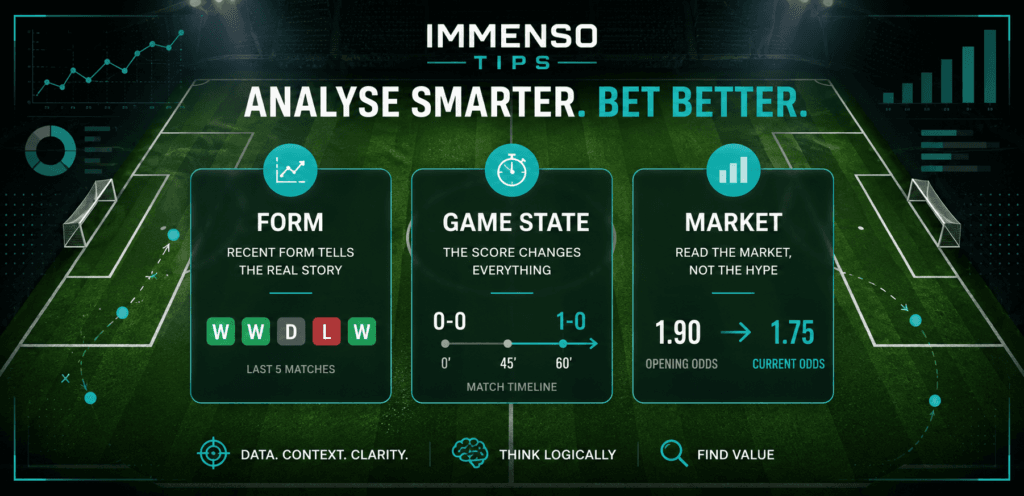
At Immenso Tips, the basic idea is simple: no hype, just logic. Before looking at any football prediction, bet builder or acca, there are three things worth checking first:
- Recent form, not just league position
- Game state, because teams change depending on the score
- The market, because obvious picks are usually already priced in
This guide breaks down those three steps in plain English. You can also browse more football education articles in our football betting guides section.
How to analyse a football match for betting without guessing
Football is a low-scoring sport. That matters. A team can dominate the ball, create better chances, hit the post twice and still draw 0-0. Another team can score from one deflection and win a game they barely controlled.
That is why football predictions are never guaranteed. Good analysis can help you make better decisions, but it cannot remove risk. The aim is not to predict every result perfectly. The aim is to understand whether your thinking makes sense before you back an opinion.
The biggest mistake beginners make is starting with the wrong question. They ask, “Who is higher in the table?” or “Who is the bigger club?” A better question is: “What is actually happening with these teams right now?”
That starts with form.
Principle 1: Analyse recent form before the league table
The league table is useful, but it can be misleading. It tells you what a team has done across the season. It does not always tell you how they are playing right now.
A team can sit high in the table because they had a strong start, an easier run of fixtures, or several narrow wins earlier in the season. Another team can sit lower because they had injuries, a tough schedule, or a poor start under a previous manager.
If you only look at the table, you are often reading old information. A proper approach to how to analyse a football match for betting starts with current performance, not reputation.
Why the table can lie
Imagine a team sitting third in the league. On paper, they look strong. But their last five matches are:
- Draw
- Loss
- Narrow win
- Loss
- Draw
Now look deeper. They have stopped creating clear chances. They are conceding more shots. Their key midfielder is injured. Their recent win came from a late penalty. The table still says “top-three team”, but the football says they are struggling.
That is why recent form matters.
The opposite can also happen. A team sitting 14th might look poor at first glance, but their recent form could show improvement. Maybe they have changed manager, tightened up defensively, or got important players back from injury. The table has not caught up yet, but the performances are improving.
How to read recent form properly
Looking at the last five matches is a good starting point. It gives you a quick snapshot of current momentum. But do not treat it as the full answer.
A last-five form line only tells you the results. It does not tell you the context.
When checking recent form, ask:
- Who did they play?
- Were those teams strong or weak?
- Were the matches home or away?
- Did they actually play well, or just get results?
- Were they missing key players?
- Did they score from repeatable chances or lucky moments?
A team winning three straight games against bottom-half opponents is not the same as a team taking points from strong sides. A team losing narrowly to title contenders may be in better shape than the table suggests.
The result matters, but the performance behind the result matters more.
Home and away form matters
Overall form can hide important details. Some teams are completely different at home compared to away.
A side might press high, attack aggressively and create plenty at home, but become passive away from home. Another team might struggle to control matches at home but be dangerous on the counter away.
Before judging a fixture, split the form properly:
- Look at the home team’s recent home matches
- Look at the away team’s recent away matches
- Check goals scored and conceded in those specific conditions
- Check whether the team style changes depending on venue
This is especially useful for markets like both teams to score, over 2.5 goals, corners and bet builders. A team’s home pattern can be much stronger than their overall record.
Fixture difficulty changes everything
Form is not just wins, draws and losses. It is also who those results came against.
A team can look brilliant after beating three weak sides in a row. But if those opponents were open, disorganised and low on confidence, the run may not mean as much as it seems.
Another team can look poor after losing to three strong teams, but the performances might still have been competitive.
So before taking form at face value, ask one simple question:
Would this form look the same if the fixture list had been harder?
That question stops you overrating streaks and underrating teams who have simply had a tough run.
Injuries, rotation and motivation
Recent form can change quickly when the team changes.
If a club has lost two centre-backs, the defensive record from previous weeks may not mean much. If their main striker is suspended, their attacking numbers might drop. If they played 120 minutes in a cup match three days ago, intensity can suffer.
Motivation matters too. A team fighting relegation, chasing Europe or trying to win the title may approach a match differently to a side sitting safely in mid-table.
This does not mean “must win” automatically means they will win. That is another common mistake. But motivation should be part of the context, especially late in the season.
Principle 2: Use game state in football betting analysis
Game state is one of the most important parts of football analysis, and it is also one of the things beginners miss most often.
Game state simply means the situation of the match: the score, the time, and what each team needs at that moment.
A 1-0 lead after 10 minutes is not the same as a 1-0 lead after 80 minutes. A team chasing a goal behaves differently to a team protecting a lead. That changes the whole match.
This is a key part of how to analyse a football match for betting because many markets depend on match flow, not just team quality.
Teams change when they are winning
When a team is winning, they often reduce risk. They may sit deeper, slow the tempo and protect the middle of the pitch. They might allow the opponent to have more of the ball, but try to keep them away from clear chances.
That can change the stats.
The team leading might have less possession after scoring. They might take fewer shots. They might focus more on counter-attacks. Looking only at the final possession numbers can make the match look different from how it actually played out.
This is why game state matters. The same team can look attacking at 0-0 and cautious at 1-0.
Teams change when they are chasing
When a team is losing, they usually have to take more risks. Full-backs push higher. Midfielders make more forward runs. More players attack the box.
This can create more pressure, more shots and more corners. It can also leave space behind for the opponent.
That is why a match can open up after one goal. A team chasing the game creates more, but also concedes more dangerous counter-attacks. This is where markets like both teams to score, second-half goals, corners and cards can become more interesting than just picking the match winner.
Game state and goals markets
Game state is especially important for goal markets.
For example, imagine a strong home favourite is drawing 0-0 at half-time. They have dominated possession, had several shots and missed one big chance. The away side are sitting deep and would clearly take a point.
That does not guarantee second-half goals. But the logic is clear: the favourite may have to increase the tempo after the break, while the away side may become tired from defending. That can create a different second-half pattern.
Now imagine the same favourite scores after 12 minutes. The whole match changes. They might slow down, manage the game and stop attacking with the same urgency. The underdog might push forward and leave space.
Same teams, different score, different match.
Game state and corners
Corners are heavily affected by pressure.
If a strong attacking team falls behind, they may spend long spells forcing the ball wide, crossing, shooting from blocked positions and winning corners. If they are already 2-0 up, they may not need to attack with the same intensity.
That is why corner analysis should not only be based on average corners per match. You also need to think about likely match flow.
Who is more likely to chase? Who is more likely to defend deep? Who creates pressure when behind? Who allows pressure when leading?
Game state and cards
Cards can also change with game state.
A team protecting a narrow lead may commit more tactical fouls. A team chasing the game may become frustrated. A defender facing repeated counter-attacks may be forced into risky challenges.
This does not mean every tight match will have cards. But it does mean the scoreline and pressure of the game can matter as much as the referee or league average.
Principle 3: Read the betting market before the hype
The third step is the one most people get wrong.
They find something that looks obvious and assume it is a good pick. But if something looks obvious to you, it probably looks obvious to the market too.
That matters because the odds already reflect what most people think.
What football odds really mean
Odds are not just random numbers. They are prices. They reflect the market’s view of probability, plus the bookmaker’s margin.
If a team is priced at 1.50, the market is saying they are strongly expected to win. If a team is priced at 4.00, the market is saying they are much less likely to win.
That does not mean the favourite is guaranteed. It also does not mean the outsider is automatically value.
The key question is not “Will this happen?” The better question is:
Is the price fair for how often this should happen?
Obvious favourites are usually already priced in
Let’s say a big club are at home to a weaker side. They are higher in the table, they have better players, and everyone expects them to win.
That does not automatically make them a good bet.
When the odds are very short, the market has already priced in their strength. Saying the better team should win is not spotting anything new. Everyone can see that.
This is where beginners confuse likelihood with value.
A team can be likely to win and still be poor value at the price. Another team can be less likely to win but still be overpriced by the market.
Short odds are not the same as safe odds
One of the biggest mistakes in football betting is treating short odds as safe.
Football does not work like that. Red cards happen. Penalties happen. VAR decisions happen. A favourite can dominate and still fail to win. A goalkeeper can have the match of his life. A team can create one chance and score.
Short odds simply mean the outcome is considered more likely. They do not remove risk.
This becomes even more important in accas and bet builders. Adding several short-priced selections together can feel sensible, but every extra leg adds another way for the bet to fail.
Big odds are not automatically value
The opposite mistake is thinking big odds mean value.
They do not.
Big odds usually mean the outcome is unlikely. A 10.00 correct score might look exciting, but it needs a very specific match outcome to land. Unless there is a clear reason why the market has underrated that result, it is just a long shot.
Value is not about finding the biggest price. It is about finding a price that is bigger than it should be.
What odds movement can tell you
Odds can move before kick-off for several reasons. Team news, injuries, heavy money, tactical information and public opinion can all shift a price.
For example, if a home team moves from 1.90 to 1.70 after the away team’s main striker is ruled out, the market has reacted to that information.
That does not mean the home team will win. It means the price has changed because the market now sees the match differently.
Chasing a price after it has already moved can be dangerous. You may be backing the right idea at the wrong number.
How to analyse a football match for betting: simple checklist
Before backing a football opinion, work through this simple checklist. It keeps the process clear and helps you avoid forcing a pick when the match does not suit one.
1. Check recent form
Look at the last five to ten matches. Do not only count wins and losses. Ask whether the team has actually played well.
2. Split home and away form
Check the home team’s recent home matches and the away team’s recent away matches. Overall form can hide big differences.
3. Check the quality of opponents
A good run against weak teams can flatter a side. A poor run against top teams can make a side look worse than they are.
4. Check team news
Look for key injuries, suspensions, rotation and returning players. Focus on positions, not just names. Missing centre-backs or defensive midfielders can change a match completely.
5. Check motivation and schedule
Is one side fighting for the title, Europe or survival? Did either team play midweek? Could rotation matter?
6. Think about tactical style
Does one team dominate possession? Does one sit deep and counter? Does either team struggle against pace, set pieces or crosses?
7. Think about game state
What happens if the favourite scores first? What happens if the underdog scores first? Which team is more likely to chase the game?
8. Check goal patterns
Look at recent goals scored and conceded, but also the type of chances created. A team scoring from very few shots may cool down.
9. Look for defensive weaknesses
Do they concede lots of shots? Set-piece chances? Late goals? Space behind the full-backs? Link the weakness to the opponent’s strength.
10. Read the market
Look at the odds and ask what the market is already saying. If your reasoning is obvious, the price may already reflect it.
11. Know when not to bet
This is part of good analysis. If the match is messy, the price is poor, or your reasoning is weak, leaving it alone is a decision too.
Example: when BTTS makes more sense than picking a winner
Imagine two mid-table teams with strong attacking numbers and weak defensive records. Both have scored regularly in recent weeks, but both concede chances from wide areas and set pieces.
The home team are better at home. The away team carry pace on the counter. Neither side looks reliable enough to trust fully on the match result.
This is where both teams to score may tell the story better than the 1X2 market. You are not forcing a winner. You are reading the match pattern.
This is the sort of thinking that should come before any football bet builder or acca. The market should match the football logic, not the other way round.
You can read more about related football betting markets in our football betting guides, including BTTS, over 2.5 goals, bet builders and odds education.
Example: when the favourite looks too short
Now imagine a big team at home. They are 1.25 to win. On the surface, it looks simple. They have better players, they are higher in the table, and they are expected to dominate.
But the away team have lost only one of their last six away games. They defend deep, slow matches down and rarely concede more than one goal. The favourite also played in Europe during the week and may rotate.
The favourite can still win. The real question is whether the price leaves enough room for the risk.
This is why “they should win” is not enough. At short odds, the standard is higher, so the price still needs to make sense.
Example: when game state creates second-half pressure
Picture a strong home side drawing 0-0 at half-time. They have had most of the ball, the away side are sitting deep, and the crowd is starting to get impatient.
The second half may look completely different. The home team may push harder. The away team may defend deeper. Corners, shots and pressure can build quickly.
That does not guarantee a goal, but it explains why second-half markets often depend more on game state than pre-match averages.
Football is not static. The match changes as soon as the score changes.
How this helps with accas and bet builders
This framework is useful whether you are reading today’s football tips, checking tomorrow’s football tips, building a daily acca or looking at a bet builder.
For accas, it helps you avoid adding legs just because they look short. Every selection should have its own football reason.
For bet builders, it helps you build a more connected story. For example, if you expect a favourite to dominate territory, corners and shots might connect logically. If you expect both teams to attack, BTTS and goals markets may connect better than forcing a match winner.
The key is to avoid random combinations. A good bet builder should be based on match flow, not just a list of selections that sound possible.
You can also read more in the full Immenso Tips guides library.
Common beginner mistakes when analysing football matches
Only looking at the league table
The table matters, but it is not enough. Always check current form, home and away splits, injuries and fixture difficulty.
Trusting short odds too much
Short odds mean more likely, not guaranteed. Football has too much variance for any price to be treated as certain.
Thinking big odds mean value
A big price is not automatically a good price. It usually means the outcome is unlikely. You need a clear reason why the market has underrated it.
Ignoring game state
Teams do not play the same way at 0-0, 1-0 or 0-1. The score changes tactics, pressure, tempo and risk.
Adding too many legs
Every extra acca or bet builder leg adds risk. A selection should not be included just because it increases the odds.
Final thoughts: how to analyse a football match for betting with logic
You do not need to overcomplicate football analysis. Start with three questions:
- What does recent form really say?
- How could game state change the match?
- Is the market already pricing in the obvious story?
That simple process will not guarantee winners. Nothing can. But it will stop you relying on lazy assumptions like “they are higher in the table” or “the odds are short so it must be safe”.
The better you understand the match, the calmer your decisions become.
No hype. Just logic.
Responsible football betting
Football analysis can help you make more informed decisions, but it cannot guarantee profit. Odds are prices, not promises, and every bet carries risk.
Only bet with money you can afford to lose. Set a clear budget before you start, avoid chasing losses, and do not increase stakes because of frustration or emotion. If a match is unclear or the price does not make sense, not betting is a valid decision.
If betting stops feeling fun, starts affecting your finances, or becomes difficult to control, take a break and seek support. For free, confidential help in the UK, visit GambleAware or GamCare. You can also contact the National Gambling Helpline on 0808 8020 133.
FAQ: how to analyse a football match for betting
These answers cover the most common beginner questions around how to analyse a football match for betting without relying only on league position or short odds.
How do beginners analyse a football match for betting?
Start with recent form, home and away records, team news, motivation, tactical style and the betting market. Do not rely only on the league table or the name of the bigger club.
Is recent form more important than league position?
Recent form can be more useful than league position when judging how a team is playing right now. The table shows the whole season, while form shows the current trend. The best approach is to use both, with context.
How many matches should I look at for football form?
The last five matches are a simple starting point, but five games can be misleading. Where possible, look at the last eight to ten matches, home and away splits, opponent quality and performance stats.
What is game state in football betting?
Game state means the score, time and situation of the match. When teams are winning, drawing or losing, their behaviour changes, which can affect goals, shots, corners, cards and overall tempo.
Are short odds always safer?
No. Short odds mean an outcome is more likely, not guaranteed. In football, even strong favourites can draw or lose because of red cards, missed chances, injuries, VAR decisions or simple variance.
What is the difference between probability and value?
Probability is how likely something is to happen. Value is whether the odds are bigger than the true chance of that outcome. A likely outcome can still be poor value if the price is too short.
Can football analysis guarantee profit?
No. Football analysis can improve decision-making, but it cannot guarantee profit. Any guide, tip, acca or bet builder should be treated as opinion, not certainty.
free daily updates
Join our free Telegram channel
Get daily football tips, accas and bet builder ideas from Immenso Tips.
join free telegram