
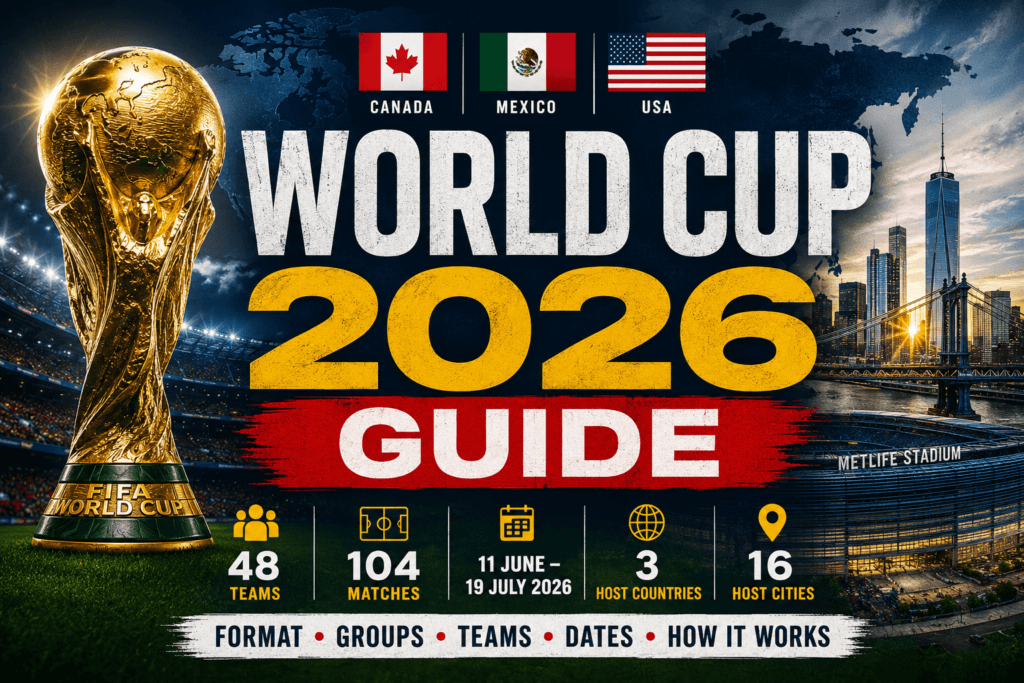
This World Cup 2026 guide breaks down the biggest version of the tournament ever: 48 teams, 104 matches, three host countries and a brand-new knockout route. Canada, Mexico and the United States are sharing the tournament, which runs from Thursday 11 June to Sunday 19 July 2026.
The opening match is Mexico vs South Africa in Mexico City, while the final takes place at MetLife Stadium in New Jersey. You can check the official FIFA World Cup 2026 match schedule on FIFA’s fixture page.
The main thing fans need to know is simple: the old 32-team format is gone. World Cup 2026 has 12 groups of four teams, with the top two from each group going through, plus the eight best third-placed teams. That creates a new round of 32 before the usual knockout stages continue.
How many teams are in the 2026 World Cup?
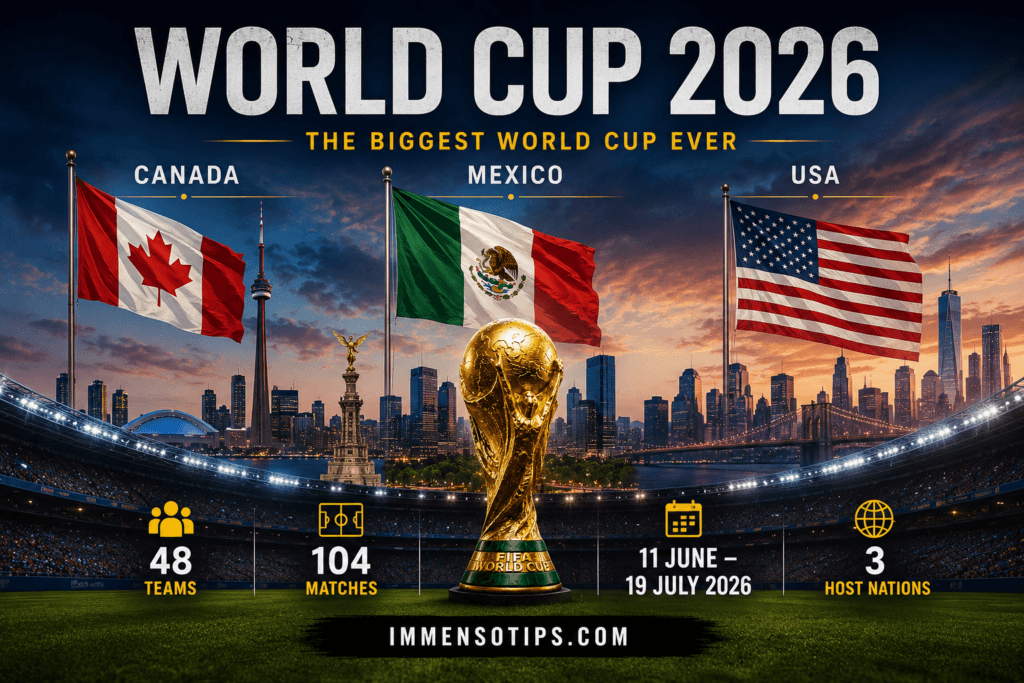
The 2026 World Cup features 48 teams. That is a big jump from the 32-team format used between 1998 and 2022.
More teams means more matches, more smaller nations involved, and more routes into the knockout stage. It also means the tournament is longer and harder to read than before. In the old format, half the teams went out after the group stage. This time, 32 of the 48 teams continue into the knockouts.
Where is the 2026 World Cup being played?
The tournament is being hosted across three countries: Canada, Mexico and the United States.
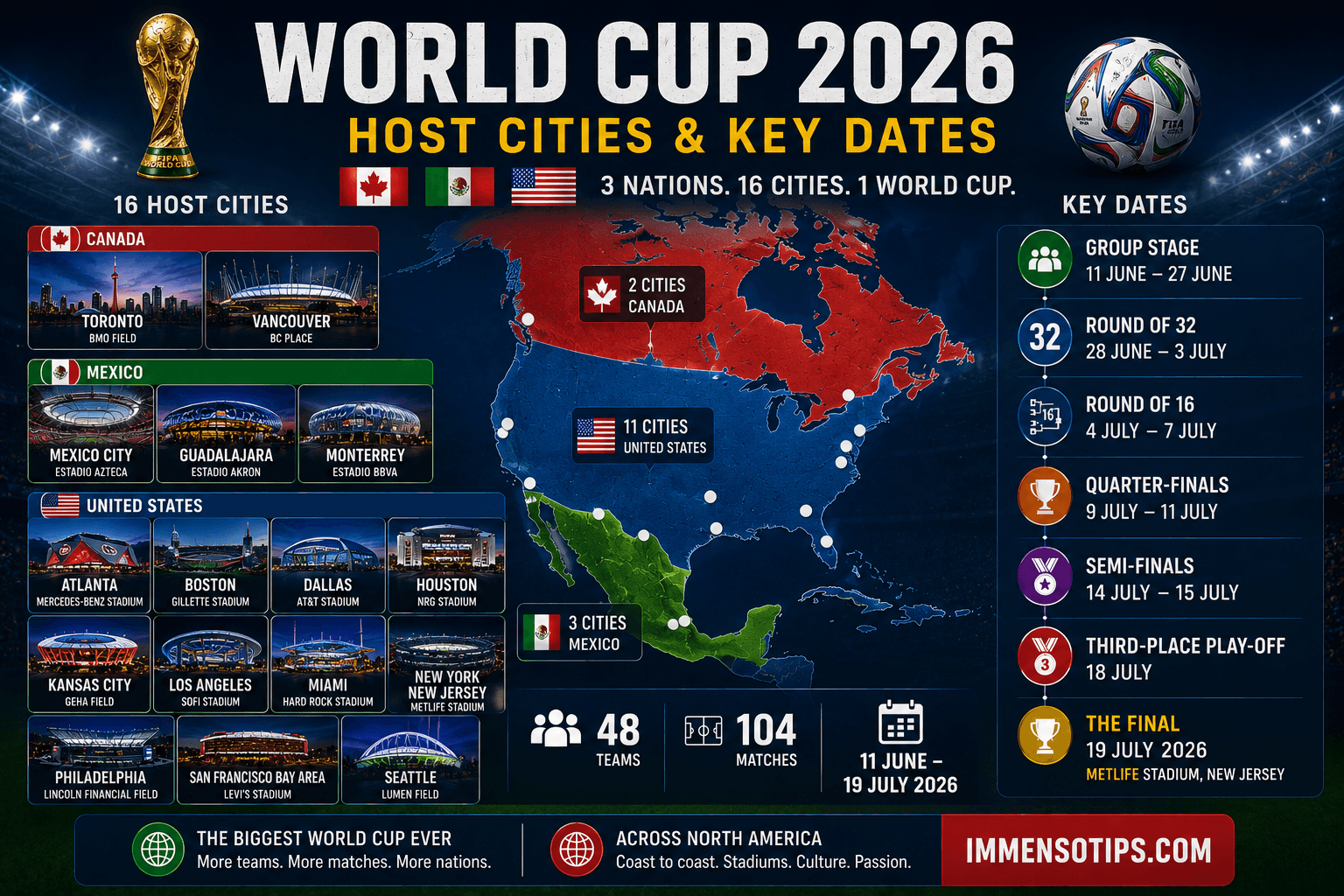
There are 16 host cities in total. Canada has Toronto and Vancouver. Mexico has Mexico City, Guadalajara and Monterrey. The United States has the biggest share, with matches in Atlanta, Boston, Dallas, Houston, Kansas City, Los Angeles, Miami, New York New Jersey, Philadelphia, San Francisco Bay Area and Seattle.
For the official venue list, FIFA has a full World Cup 2026 host cities page covering every location across Canada, Mexico and the United States.
That gives World Cup 2026 a huge footprint. This is not a compact tournament where teams and fans stay in one small area. Travel, time zones and recovery will matter.
World Cup 2026 key dates
| Stage | Dates |
|---|---|
| Group stage | 11 June to 27 June |
| Round of 32 | 28 June to 3 July |
| Round of 16 | 4 July to 7 July |
| Quarter-finals | 9 July to 11 July |
| Semi-finals | 14 July to 15 July |
| Third-place play-off | 18 July |
| Final | 19 July |
How does the World Cup 2026 format work?
The format is one of the main reasons this World Cup 2026 guide is needed, because the tournament no longer works like the old 32-team version.
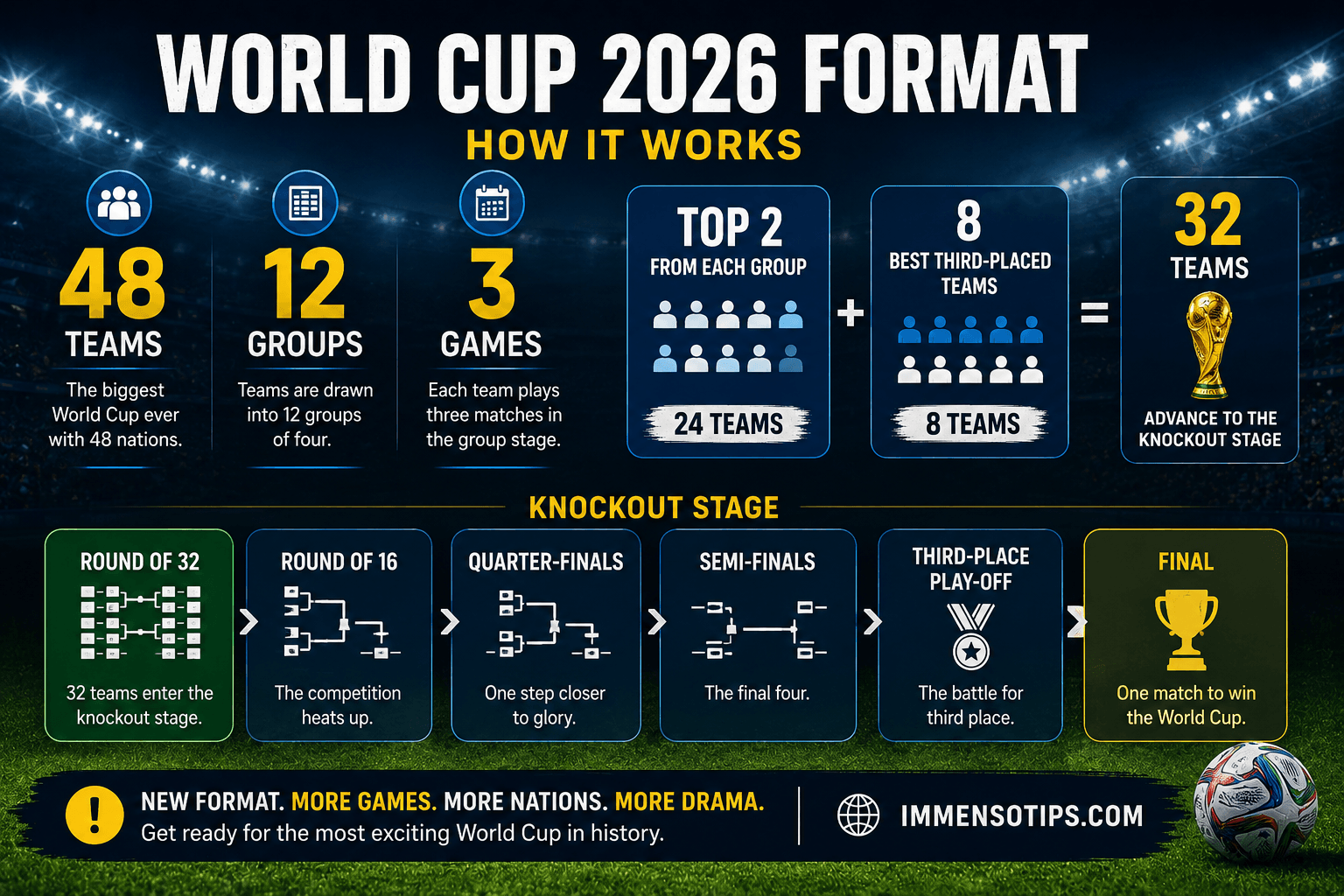
- 48 teams enter the tournament.
- They are split into 12 groups of four.
- Each team plays three group matches.
- The top two teams in every group qualify.
- The eight best third-placed teams also qualify.
- That leaves 32 teams in the knockout stage.
From there, it becomes straight knockout football. Round of 32, round of 16, quarter-finals, semi-finals, third-place play-off and final.
The big change is the extra knockout round. To win the World Cup, a team may now need to play eight matches instead of seven. Squad depth, rotation and travel planning will be bigger than ever.
FIFA has also explained the expanded format, including the 12 groups of four and the route into the round of 32, on its official format guide.
How do third-placed teams qualify?
This is where the new format gets interesting.
The top two from each group qualify automatically, giving us 24 teams. To reach 32, FIFA also takes the eight best third-placed teams from across the 12 groups.
That means finishing third is not automatically a disaster. Four points will often be enough. Three points may also be enough if the goal difference is strong, but that will depend on what happens across the other groups.
This should make the final round of group matches messy in the best possible way. Some teams will know a draw is enough. Others may need to win. Some may need goals. Cards could even matter if the margins are tight.
World Cup 2026 groups
This part of the World Cup 2026 guide is where the tournament starts to feel real, with 12 groups of four and plenty of awkward routes through to the knockouts.
| Group | Teams |
|---|---|
| Group A | Mexico, Czech Republic, South Africa, South Korea |
| Group B | Canada, Bosnia and Herzegovina, Qatar, Switzerland |
| Group C | Brazil, Haiti, Morocco, Scotland |
| Group D | United States, Australia, Paraguay, Turkey |
| Group E | Curaçao, Ecuador, Germany, Ivory Coast |
| Group F | Netherlands, Japan, Sweden, Tunisia |
| Group G | Belgium, Egypt, Iran, New Zealand |
| Group H | Cape Verde, Saudi Arabia, Spain, Uruguay |
| Group I | France, Norway, Senegal, Iraq |
| Group J | Algeria, Argentina, Austria, Jordan |
| Group K | Colombia, Jamaica, Portugal, Uzbekistan |
| Group L | Croatia, England, Ghana, Panama |
England’s World Cup 2026 group
England are in Group L with Croatia, Ghana and Panama.
It is a group with a bit of everything. Croatia bring tournament experience and control in midfield. Ghana bring physicality and pace. Panama are the underdogs, but England already know from 2018 that these games still need to be handled properly.
England’s group fixtures are:
- England vs Croatia, Wednesday 17 June, 9pm UK time
- England vs Ghana, Tuesday 23 June, 9pm UK time
- Panama vs England, Saturday 27 June, 10pm UK time
On paper, England should expect to qualify. The Croatia game may decide who controls the group.
Scotland’s World Cup 2026 group
Scotland are in Group C with Brazil, Morocco and Haiti.
That is a proper World Cup group. Brazil are the headline name, Morocco have proven they can handle elite tournament football, and Haiti will see the Scotland game as their big chance to make a statement.
Scotland’s group fixtures are:
- Haiti vs Scotland, Sunday 14 June, 2am UK time
- Scotland vs Morocco, Friday 19 June, 11pm UK time
- Scotland vs Brazil, Wednesday 24 June, 11pm UK time
The Haiti match looks massive. Scotland may need a strong start before the Morocco and Brazil games turn the pressure up.
How do World Cup 2026 tiebreakers work?
If teams finish level on points in the group, tiebreakers decide the order.
The first checks are based on the matches between the tied teams. That means head-to-head points, head-to-head goal difference and head-to-head goals scored come first.
If teams still cannot be split, the tiebreakers move to the full group record, including overall goal difference and overall goals scored. After that, fair play can come into it, so yellow and red cards could matter.
Fair play deductions are usually:
- Yellow card: minus 1
- Second yellow / indirect red: minus 3
- Straight red card: minus 4
- Yellow card plus straight red: minus 5
That might sound minor, but in a 48-team tournament where third-placed teams are being compared across groups, discipline could become important. One needless red card could change a team’s route.
What happens in the knockout stage?
The knockout stage starts with the round of 32.
From this point, there is no table, no second chance and no room to recover from a bad night. If a match is level after 90 minutes, it goes to extra time and then penalties if needed.
The route is:
- Round of 32
- Round of 16
- Quarter-finals
- Semi-finals
- Third-place play-off
- Final
The new round of 32 is the biggest structural change. It gives more teams a knockout match, but it also means the eventual champions may need to survive one more pressure game than previous winners.
UK kick-off times: expect late nights
For UK fans, the 2026 World Cup will be a different viewing experience.
Because the tournament is being played across North America, kick-off times will be spread across several time zones. Some matches will be perfect for UK viewing. Others will be late-night or early-morning jobs.
The good news is that England’s group matches are all in strong evening slots for UK viewers. The final is also scheduled for 8pm UK time on Sunday 19 July.
The bad news is that plenty of group-stage games will kick off after midnight. If you want to watch everything, forget normal sleep for a month.
What does the bigger format change?
The 48-team format changes the feel of the tournament.
First, more countries get a shot. That is good for global football and gives fans more stories outside the usual elite nations.
Second, it makes the group stage harder to judge. With eight third-placed teams going through, some teams will qualify without finishing in the top two. That means a slow start is not always fatal, but goal difference and discipline become more important.
Third, squad strength matters more. The best teams will not just need a strong starting XI. They will need 20 or more players ready to contribute, especially with travel, heat, recovery and the extra knockout round all adding up.
Why World Cup 2026 could feel different
This tournament should feel huge. Not just because of the number of teams, but because of the geography.
One day the tournament could be in Mexico City. The next major game could be in New Jersey, Los Angeles, Toronto or Vancouver. That scale will make it look and feel different from Qatar 2022 or Russia 2018.
For teams, travel planning will matter. For fans, time zones will matter. For anyone following the football properly, group maths will matter more than ever.
The simple version is this: World Cup 2026 is bigger, longer, wider and more unpredictable.

World Cup 2026 FAQs
Use this World Cup 2026 guide as a simple reference point for the format, dates, groups and knockout route as the tournament gets closer.
How many teams are in the 2026 World Cup?
There are 48 teams in the 2026 World Cup.
How many groups are there?
There are 12 groups of four teams.
How many teams qualify from each group?
The top two teams from each group qualify automatically. The eight best third-placed teams also go through.
How many matches are there?
There are 104 matches in total.
When does the 2026 World Cup start?
The tournament starts on Thursday 11 June 2026.
When is the World Cup 2026 final?
The final is on Sunday 19 July 2026 at MetLife Stadium in New Jersey.
Who are the host countries?
Canada, Mexico and the United States are co-hosting the tournament.
Can third-placed teams qualify?
Yes. The eight best third-placed teams qualify for the round of 32.
What group are England in?
England are in Group L with Croatia, Ghana and Panama.
What group are Scotland in?
Scotland are in Group C with Brazil, Morocco and Haiti.
Final word
World Cup 2026 is going to take some getting used to. More teams, more games, more late nights and a new knockout route.
The basics are simple enough: 48 teams, 12 groups, 32 through to the knockouts. But the details are where it gets interesting. Third-place qualification, fair play tiebreakers, huge travel distances and UK kick-off times will all shape the tournament.
It should be chaotic, but in the right way. This is the biggest World Cup ever, and it is built to give fans football every day, storylines everywhere and plenty to argue about before the knockouts even begin.
You can also check today’s football tips for current selections, or visit our football betting guides for more football analysis and tournament guides.
free daily updates
Join our free Telegram channel
Get daily football tips, accas and bet builder ideas from Immenso Tips.
join free telegram